
Quick Answer: A washer dryer not drying clothes is usually caused by a blocked filter, overloaded drum, faulty heating element, or blocked condenser/vent. Cleaning the filter and reducing load size fixes many cases – if the machine runs but produces no heat, it’s likely a heating element fault needing a professional repair.
Introduction: Washer Dryer Not Drying Clothes
Washer Dryer Not Drying Clothes: You load the washer dryer, press start, and expect warm, dry clothes a few hours later. Instead, they come out cold and damp, sometimes even after a second cycle.
It’s one of the most common faults we see across Ilford, Romford, Hornchurch, Dagenham, Upminster, Brentwood and Rainham — and the frustrating part is the machine often looks like it’s working perfectly. The drum spins, the display shows a normal cycle, but the clothes simply don’t dry.
Below, we’ll walk through the real causes engineers actually find on site, a symptom checker to help you narrow down the problem, simple steps you can try yourself, and when it’s time to bring in a professional.
Washer Dryer Not Drying Clothes – Common Causes Explained
1. Blocked Filter or Pump
A clogged filter restricts airflow and drainage, the single most common cause we see on call-outs.
Signs: clothes come out damp, the cycle runs longer than usual, water doesn’t drain properly.
Common Mistake: Assuming a longer cycle will eventually dry the clothes anyway. A blocked filter doesn’t just slow drying down — it often prevents the machine reaching proper drying temperature at all.
This is one of the top issues behind front load washer dryer not drying clothes cases we see in Ilford specifically, where lint builds up faster in heavily used household machines.
2. Overloaded Drum
Washing a load fine doesn’t mean it’ll dry fine. Drying needs space for heat and air to circulate around each item — a drum packed for washing is often too full for drying.
Professional tip: As a rule of thumb, a drying load should fill no more than two-thirds of the drum.
3. Faulty Heating Element
No heat means no drying, full stop. If the machine runs through a complete cycle but the clothes come out cold rather than damp-warm, this is the most likely cause.
We see this often in:
- Hoover washer dryer not drying cases — typically heating element or thermostat related
- Zanussi washer dryer not drying cases — often linked to the heating element or a faulty NTC sensor
Warning: A heating element fault is an electrical repair. Don’t attempt to access or test it yourself — this is a job for a qualified engineer.
4. Blocked Condenser or Vent
Dryers rely on airflow to remove moisture. If the condenser unit or vent is blocked:
- Moisture stays trapped in the drum
- Clothes remain damp even after a full cycle
- The machine can run hotter than normal, risking further damage
5. Door Lock or Sensor Issues
Modern washer dryers use sensors to detect moisture levels and won’t complete drying properly if these fail or give incorrect readings.
6. Drainage Problems
If water isn’t fully draining between wash and dry phases, the drying cycle has to work much harder — and often fails to finish the job. This shares the same root causes as a washing machine not draining properly, so if you’ve had drainage issues before, it’s worth checking the pump and filter first.
Related issue: Dishwasher not draining water also shares similar drainage faults.
Quickly see the most common reasons a washer dryer leaves clothes damp and learn which issues you can safely check at home before booking a repair.
Brand-Specific Issues: Hoover & Zanussi
Hoover Washer Dryer Not Drying
Hoover washer dryers commonly develop drying faults linked to the heating element, the door seal (which affects how heat is retained), or a blocked condenser tray, which is easy to overlook since it sits behind the drum on most models.
Zanussi Washer Dryer Not Drying
Zanussi machines often show drying faults tied to the heating element or temperature sensor. A Zanussi that washes normally but produces only lukewarm or cold air during drying usually points to one of these two components.
Did You Know? Most major brands — Hoover, Zanussi, Bosch, Samsung, Beko — share the same core fault categories. The brand affects which part is likely to fail, not the underlying cause.
Symptom Checker Table
| Symptom | Likely Cause | DIY or Professional? |
|---|---|---|
| Clothes damp, cycle takes longer than usual | Blocked filter | DIY — clean filter |
| Clothes dry unevenly, some items still wet | Overloaded drum | DIY — reduce load size |
| Machine runs, no heat at all | Faulty heating element | Professional |
| Clothes stay damp, machine feels hot to touch | Blocked condenser/vent | DIY clean, then Professional if unresolved |
| Cycle won’t complete or keeps resetting | Door lock/sensor fault | Professional |
| Standing water after wash before drying starts | Drainage/pump blockage | DIY check, then Professional |
| Burning smell during drying | Heating element or lint buildup | Stop use — Professional immediately |
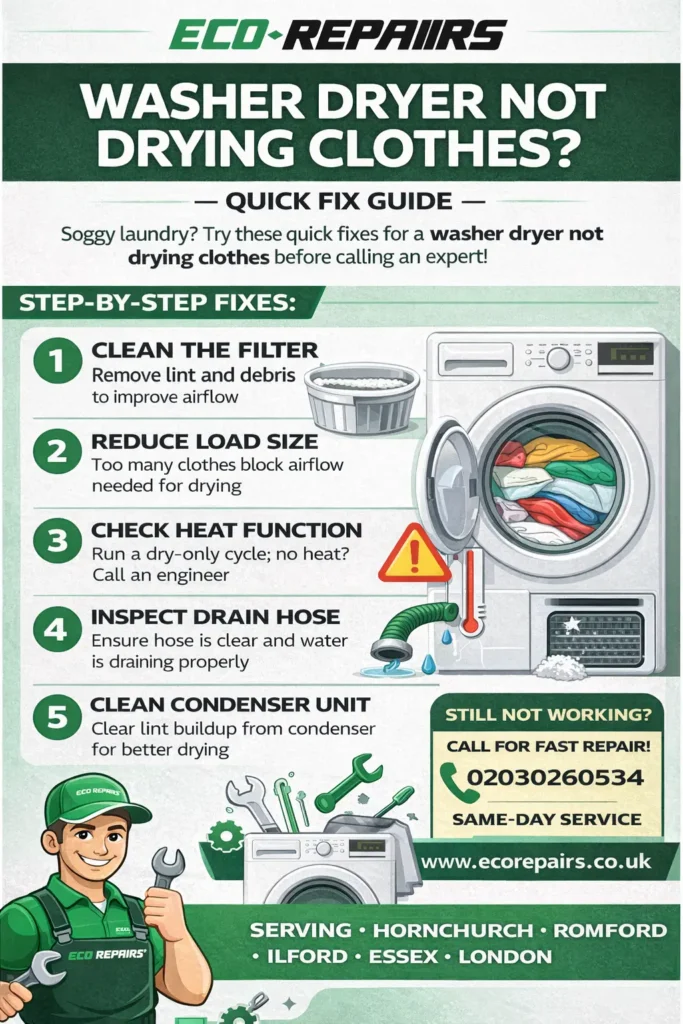
Step-by-Step Fix Guide
Before booking an engineer, these steps resolve a good proportion of cases:
Step 1: Clean the Filter
Remove lint and debris, then rinse under warm water.
Step 2: Reduce Load Size
Run a smaller load and check whether drying improves.
Step 3: Check the Heat Function
Run a dry-only cycle. No heat at all strongly suggests a heating element fault.
Step 4: Inspect the Drain Hose
Check for kinks or blockages and confirm water flows freely.
Step 5: Clean the Condenser Unit
Especially important for condenser washer dryers — remove lint buildup to restore airflow.
Step 6: Reset the Machine
A simple power-off reset sometimes resolves sensor glitches.
Expert Tip: Try these in order. If you reach Step 3 and there’s genuinely no heat at all, you can usually skip straight to booking a repair — heating elements aren’t a DIY fix.
Condenser vs Vented vs Heat Pump: Does It Matter?
| Type | How It Works | Common Drying Fault |
|---|---|---|
| Vented | Expels warm, damp air outside via a hose | Blocked or kinked vent hose |
| Condenser | Condenses moisture into a removable water tank | Blocked condenser unit, full water tank |
| Heat Pump | Recycles heat for efficiency | Blocked heat exchanger, longer cycle times if dirty |
If you’re not sure which type you have, check whether there’s an external vent hose (vented) or a water tank to empty (condenser/heat pump) — this affects exactly where the blockage is likely to be.
Real Repair Examples
Washing Machine/Washer Dryer Example
A household in Romford had a washer dryer that washed perfectly but never dried properly. On inspection, the cause was a blocked condenser combined with an overloaded drum — a deep clean and some guidance on load size resolved it the same day.
Dishwasher Example
A separate call-out in Ilford involved standing water in a dishwasher. The cause was a blocked pump, resolved by clearing debris and cleaning the filter — a useful reminder that drainage faults follow similar patterns across dishwasher not draining issues too.
Oven Example
An oven not heating properly is a useful comparison case — much like a washer dryer with no heat, the cause was a failed heating element, replaced as part of a standard repair visit.
Areas We Cover
We provide same-day appliance repair across:
Ilford • Romford • Hornchurch • Dagenham • Upminster • Brentwood • Rainham • and the wider Essex & Greater London area.
Whether it’s a front load washer dryer not drying clothes in Ilford, a Hoover unit in Romford, or a Zanussi machine in Hornchurch, our engineers are familiar with the specific fault patterns most common to each brand and machine type.
Maintenance Tips to Prevent Future Issues
- Clean filters weekly — lint buildup is the single biggest cause of drying faults
- Don’t overload — follow the manufacturer’s stated drying capacity, which is often lower than the wash capacity
- Use the correct cycle for the fabric type rather than defaulting to the longest setting
- Service annually — routine maintenance catches small issues before they become breakdowns
- Keep ventilation clear on vented models — a blocked vent is one of the most preventable faults
The Energy Saving Trust’s guidance on appliance maintenance backs this up: well-maintained appliances run more efficiently and last longer, which is exactly what regular filter and condenser cleaning achieves.
Drying Clothes Without a Dryer (Temporary Fix)
If your dryer fails unexpectedly and you need a stopgap:
- Use a heated room with good airflow
- Hang clothes near a fan rather than in a closed space
- Use the towel-roll technique — rolling a damp item in a dry towel — to remove excess water before air drying
It’s not a long-term solution, but it’ll get you through until the machine’s fixed.
Why Call a Professional?
Once you’ve ruled out the simple causes — filter, load size, drainage — a persistent drying fault almost always comes down to a component that needs proper diagnosis: the heating element, thermostat, or a sensor.
Consumer guidance from Which? consistently recommends a professional check for recurring appliance faults rather than repeated workarounds, since misdiagnosing a heating fault can lead to further, more expensive damage.
Expert Tip: If you’ve cleaned the filter, reduced the load, and the machine still runs cold, that’s the point to stop troubleshooting and book an engineer — continuing to run cycles on a faulty heating element rarely helps and can sometimes make things worse.
FAQs
Q1: Why is my washer dryer not drying my clothes?
Most commonly due to blocked filters, a faulty heating element, or an overloaded drum.
Q2: Can I fix a washer dryer myself?
Simple maintenance like filter cleaning is fine to DIY, but electrical faults need a professional.
Q3: How do I know if the heating element is broken?
If the machine runs but produces no heat, the heating element is the likely fault.
Q4: When should I call an engineer?
If basic troubleshooting doesn’t resolve the issue, or the problem keeps recurring.
Q5: Is it safe to keep using a faulty washer dryer?
No, it can cause further damage or pose a safety risk.
Q6: Why is my Hoover washer dryer not drying properly?
Often the heating element, door seal, or condenser tray.
Q7: Why is my Zanussi washer dryer not drying properly?
Usually the heating element or temperature sensor.
Q8: Does an overloaded drum stop drying from working?
Yes — drying needs more airflow space than washing does.
Q9: How do I know if it’s a condenser or vented dryer fault?
Check whether you have an external vent hose (vented) or a water tank to empty (condenser) — the fault location follows from there.
Q10: How often should I service my washer dryer?
Annually, alongside weekly filter cleaning, to prevent major faults.
Q11: Can drainage issues affect drying performance?
Yes, incomplete draining before the dry cycle reduces drying effectiveness.
Q12: What should I do if my washer dryer smells burnt?
Stop using it immediately and book a professional inspection.
Q13: Is a washer dryer not drying the same issue as a tumble dryer not heating?
The underlying cause is often the same — a faulty heating element — even though they’re different appliance types.
Final Thought
A washer dryer not drying clothes properly is rarely random — it almost always traces back to one of a handful of causes: a blocked filter, an overloaded drum, a failed heating element, or a blocked condenser. Try the simple steps first, and if the machine still runs cold or the fault keeps coming back, that’s the point to bring in a professional rather than keep guessing.
Call now: 02030260534 to book same-day appliance repair across Ilford, Romford, Hornchurch, Dagenham, Upminster, Brentwood, Rainham and the wider Essex & Greater London area.